

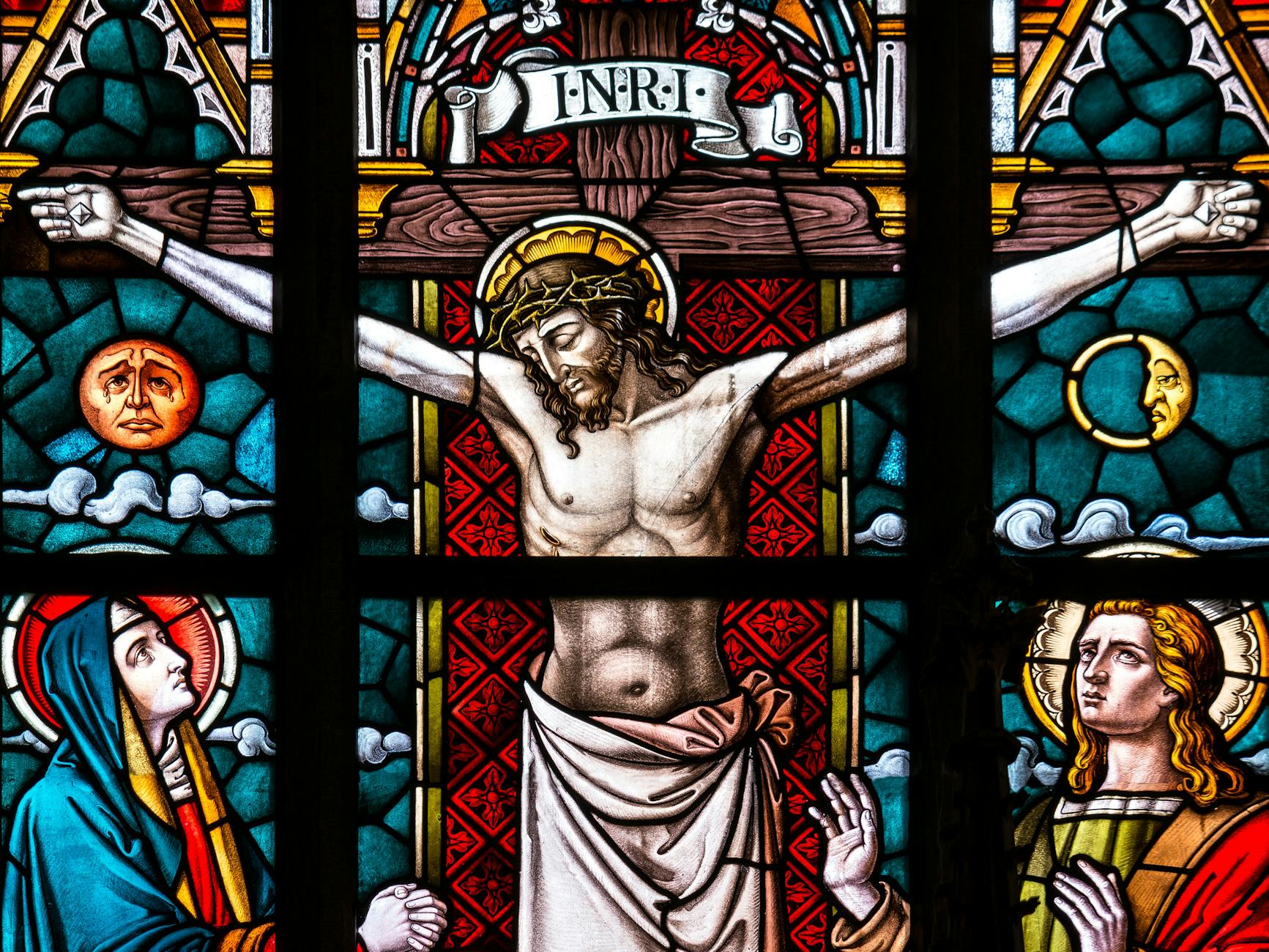
The first time I heard the question, as a faith formation teacher, about whether or not Jesus was a zombie I thought it was adorable. The student was about seven years old. We were doing preparation for First Holy Communion. It was an hour-long class on a Tuesday night, starting with a prayer service in the church and then moving us to another space to do a little lesson and a craft. Just as the lesson started, a little boy raised his hand. “Was Jesus a zombie?” he asked. His mother quickly moved to silence him.
“No! No!” I said to his mother. “It’s okay! It’s a valid question. With all of the shows on tv about the undead, it makes sense.” I turned to the little boy. “I absolutely love fantasy stories of all kinds–even those with werewolves, vampires, zombies and all those things–and believe it or not, a lot of that stuff is connected to what we believe in our faith. I really want to answer your question, using what I know about what I’ve read and watched. But we promise families that this evening session will only take an hour, and I only have about 25 minutes for us to do this lesson and craft. I know a lot of your classmates and their parents will want to go home and get ready for bed, so I don’t want to hold them up. Will you be okay staying after class so we can discuss it?”

The little boy looked at his mom, who smiled at me and nodded. I moved on with my lesson, and as the minute hand neared the 7:30pm mark, I led us in a closing prayer. Usually at this point in the class everyone was gathering their things and getting ready to charge out the door when the second hand flipped the minute from :29 to :30. I finished prayer, and everyone–all 40 of my students and parents–just sat there. I looked at them. “Okay, class is over. You all can go.”
“We want to hear the zombie thing,” a Dad in the back said.
“All of you?” I asked.
Every head in the room nodded.
I smiled, then looked a the little boy. “Well, it seems everyone is really interested in your question! See why I’m glad you asked?” I then went on to explain that zombies are not real, they are fiction, and what zombie stories tell us are about bodies that are physically animate, but empty of what makes a person a person–their soul. I then explained, from the perspective of the Catholic faith that we believe that Jesus is real, not fictional. We also believe that He is both God and the Son of God, and that while He died, He also rose from the dead whole and complete–with both His soul and God’s divinity. So while the fictional zombies are just shambling bodies devoid of anything that makes them human, Jesus is a real person who is both God and man, and is actually super-human–containing both soul and the divine nature of God the Father.
When I finished explaining I actually got applause–which I didn’t want. The little boy said thank you and gave me a hug. The dad in the back, as he was leaving the class, patted my shoulder and said, “I can’t believe you pulled that off. You’re really good at this.” Moms and Dads, Grandmas and Grandpas, Aunts and Uncles smiled at me as they left. “I’m so glad we have you,” one mom said. And the mother of the little boy stayed until last. “I didn’t know how to answer that question when he asked me,” she said. “I told him to ask you AFTER class. I’m sorry he surprised you with it as we started your lesson.”
“It’s fine!” I said. “Really! I love times like this. I love these questions. I love knowing that the kids are really thinking about their faith, about how it fits into the real and fictional parts of the world around them.”
“But isn’t it irreverent?” she asked.

“I think irreverence would be if it wasn’t a genuine question. If it was saying “zombie Jesus” as a way of making fun of our faith. A question, asked from the heart with a desire to understand, is not irreverent. It’s honest, and it’s the only way we get to some level of understanding. I’m really proud he was brave and vulnerable enough to ask it, and clearly the class appreciated it, too.”
I recalled that conversation this Easter when, on one of the Facebook groups I belong to, someone posted a similar thing. Because what happens in the group stays in the group, and I would never violate that kind of trust, I won’t repost anything detailed here, but there were a few other questions that got me thinking. Like, when Jesus came back from the dead, how did everyone know it was Him if he was in a resurrected body? (They didn’t recognize him as Jesus at first; only after He called their name). When He ascended back into heaven, could that have been an alien abduction? (Anything is possible. I mean, God could full well be an alien being who created us, if we want to put it in terms of that cosmology). But the final question–which posited that the Christian faith sounds too much like a fairy tale to be real–really got me thinking about how I would answer it. My conclusion: by writing a blog post.

I decided that to discuss fairy tales and Christianity, I’d have to bring in Orthodoxy by G.K. Chesterton. In that book he argues that one among many functions of fairy tales, fables, and myths is to introduce children to the idea, central to Christianity, that in the breaking of one rule much can be lost. If we come to accept that getting home by midnight is the condition of going to the ball to meet our prince (Cinderella); that never shining light on our lover in the dark is the condition of having an amazing life with the son of a goddess (Cupid and Psyche); that eating six seeds of the Pomegranate will lead to spending six months in the Underworld (Hades and Persephone); that guessing the name of a magic-wielder will help a mother keep her child (Rumplestiltskin)–then it will be much easier to believe that our right-standing with the Creator of the Universe was lost by the disobedience of eating a forbidden fruit. Granted, it was the disobedience, not the apple, that damaged our relationship with God, but Chesterton makes a good point. Just as school is supposed to prepare students for real life, fairy tales are a primer to help us grapple with the tenets of our faith.
So in a way, the question posed by the Facebook group member was much like when my daughter once asked, “Why do the Beatles sound so much like the Jonas Brothers?” I, of course, explained that the question is, instead, “Why do the Jonas Brothers sound so much like the Beatles,” as the Beatles are the ones who came first. Likewise, my faith predates the fairy tale, so it does not sound like a fairy tale. Fairy tales sound like my faith.

Another lesson Chesterton teaches about fairy tales and Christianity is that both give us the same road map for living in, but not being of, the world. He writes, “If our life is ever really as beautiful as a fairy-tale, we shall have to remember that all the beauty of a fairy-tale lies in this: that the prince has a wonder which just stops short of being fear. If he is afraid of the giant, there is an end of him; but also if he is not astonished at the giant, there is an end of the fairy-tale. The whole point depends upon his being at once humble enough to wonder, and haughty enough to defy. So our attitude to the giant of the world must not merely be increasing delicacy or increasing contempt: it must be one particular proportion of the two–which is exactly right. . . . Man must have just enough faith in himself to have adventures, and just enough doubt of himself to enjoy them.”
One of my most recent Catholic (thanks Father Mike Schmitz of Bible in a Year fame!) vocabulary lessons taught me that the word “holy,” means “apart.” So when we say someone or something is “holy,” we mean that it is set apart from the others, different. When people of any Judeo-Christian faith are called to be “holy,” it means we are to operate, as Chesterton said, with equal wonder and disdain for the world. It’s one of the main reasons that people can’t make sense of my politics. How can she agree with some conservative ideas but also agree with some liberal issues? Well, because my faith does not fit into the world’s politics. Trying to be “holy” means I am kept “apart” from the orthodoxy of any U.S. political party.

This is not to say I don’t struggle with many of the tenets of my faith. It’s not easy. Nor is it fun. I regularly say I’m a practicing Catholic because I am terrible at it, and need all the practice I can get. Fortunately, this is a season of mercy for all of us screw-ups. This past Sunday, sandwiched between an earthquake and an eclipse, was Divine Mercy Sunday. It focuses on the Catholic teaching that Jesus came to bring mercy to the whole world, and that just one drop of His blood would have sufficed to save every repentant person from sin. It’s one of the reasons that when we say the rosary, one of our prayers is, “Oh my Jesus, forgive us our sins, save us from the fires of hell. Lead all souls to heaven, especially those most in need of thy mercy.”
The first time I taught that prayer, one of my students said, “Those most in need of thy mercy? Does that mean we’re praying for, like, Hitler?” This was infinitely harder for me to wrap my head around than the zombie question, because between you and me, I’m seriously not a good enough Catholic to pray for the salvation of a mass-murdering psychopath. Asking mercy for him, or any genocidal lunatic, is for a way better (and more practiced) Catholic than I am. So I answered with what I know: “Catholics believe lots of people are saints–meaning they are in heaven. We never name anyone that we believe is in hell, because that decision is not for us to make. So while I find it very hard to pray for someone who committed unspeakable evil, I do believe that I am praying for someone who, at the last moment of their life, was truly sorry for the bad things they’ve done. I don’t believe Hitler was sorry. But I do believe, in the world, there are people who have made choices that have cut them off from goodness. And I believe that God can see into their hearts, and know that they’re sorry, and that even if they turn to Him in their sorry at the very last second of their lives, He will forgive them and take them into Heaven. Because as a mother, there is nothing my children could do that, if they were sorry for doing it, would lead me to turn them away. And if I, as an imperfect human, can forgive my child, how much more could God, Love Himself, forgive?”

So, on this week of Divine Mercy, I wish you the peace that only comes with forgiveness–for yourself and for others.
To that end, I will leave you with a quote from my favorite fairy-tale writer/Christian apologist, C.S. Lewis. His book, Mere Christianity, did more to help me with the tenets of my faith than years of going to church as a kid. And he, more than anyone else, brings home the connection between fantasy stories and Christianity in his Chronicles of Narnia series, which is a beautiful Christian allegory (as is Madeline L’Engle’s A Wrinkle in Time series). This excerpt is from Of Other Worlds: Essays and Stories, and exemplifies exactly why I can now see the love of my faith is inextricably woven with my love of fantasy novels:
The fairy tale is accused of giving children a false impression of the world they live in. But I think no literature that children could read gives them less of a false impression. I think what profess to be realistic stories for children are far more likely to deceive them . . . . This distinction holds for adult reading too. The dangerous fantasy is always superficially realistic. The real victim of wishful reverie does not batten on the Odyssey, The Tempest, or The Worm Ouroboros: he (or she) prefers stories about millionaires, irresistible beauties, posh hotels, palm beaches and bedroom scenes—things that really might happen . . . f the reader had had a fair chance. For, as I say, there are two kinds of longing. The one is an askesis, a spiritual exercise, and the other is a disease.
In another text Lewis writes, “If I find in myself desires which nothing in this world can satisfy, the only logical explanation is that I was made for another world.” And in this Easter season, it is to that world I look for love, forgiveness, guidance, and peace. Happy Easter, my friends. He is Risen, Alleluia! Alleluia!
Categories: Art, Diane's Voice, Living


 The Gloria Sirens