

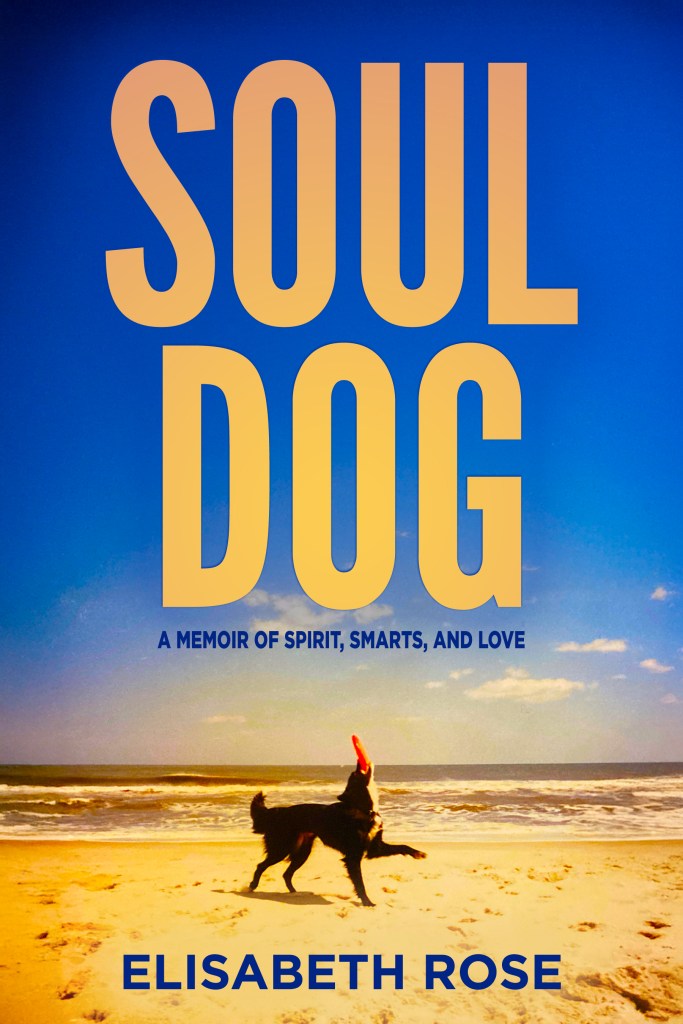
I wrote the manuscript of SOUL DOG: A MEMOIR OF SPIRIT, SMARTS, AND LOVE back in the nineteen nineties. It was first published by Harmony Books in 2001 as FOR THE LOVE OF A DOG. During the seven years before beginning that manuscript, I’d been working on a novel, and it was going nowhere. I thought, “I need a break. I need to write something I need to write.”
I took the advice I’d given to a student. He came to my office hour because he couldn’t think of a subject for his essay assignment. I asked him, “Do you have any hobbies Is there anything you’re curious about?”
He didn’t There wasn’t.
I said, “Is there anything that upsets you? Something that makes you angry?”
He said, “Well, I have leukemia.”
“Great!” I said, then clapped a hand over my mouth. “I mean–it’s not great. It’s terrible. But it’s something to write about.”
SOUL DOG isn’t exactly my leukemia, but it was for me a life-or-death topic. All my life, I loved animals. I mean, I really, really loved them. I loved them all, whether I’d met them or not. From early childhood I even loved “underdog animals,” like bats and possums and earthworms. I loved them with the same tender force that I loved my baby sister. The movie Bambi was a revelation me, and when I, at four years old, tried to talk about it, adults dismissed me. I learned that adults didn’t think animals deserved to be treated with the same regard for their well-being as did humans.
Whenever I expressed an observation that a dog or cat, bird or horse, learned something new, had a preference, made a decision, or even felt a feeling, grownups considered me silly. I learned to keep my observations to myself. I kept a close eye on adults who dared speak the truth about the animals they knew, Jane Goodall, Farley Mowat, Dian Fossey, and Konrad Lorenz.
In graduate school I finally met a professor I could talk to, Peter Schneeman. Peter rode horses among the cowboys out west. One day he gave me Vicki Hearne’s book, ADAM’S TASK: CALLING ANIMALS BY NAME and changed my life. Hearne dignified the conversations we have with animals by showing them worthy of academic discourse.
When I gave up on that novel about a fanciful woman making stuffed animals that come alive, I decided it was time to break my silence about what I knew to be true about the worth and dignity of animal life.
In keeping with the advice I gave my poor student who had leukemia, I began with what angered me most.
I was eleven years old before my parents let me have a dog, a wire-haired fox terrier named Patches, and I adored her. She immediately became the focus of not just my affection and attention, but my young intellect. I spent hours training her, completely fascinated by the communication between us. That’s why, about a year later, when a Sunday school teacher told us kids that animals didn’t go to heaven, I got so angry. It seemed absurd. Unfair. Outrageous. So as soon as I could, I went straight for the receiving line to confront the big guy, our pastor, Reverend Van Dyke. I asked him, “Do animals go to heaven?”

He said no.
“Why not?”
He said, “They don’t have souls.”
“But how do you know?”
We were holding up the line, and the conversation wasn’t so cute anymore. Annoyed, he tried to usher me along and said, “Because they can’t reason.”
“Does that mean,” I asked, “that severely brain-damaged people don’t have souls either?”
“Of course they do!” he said, and turned his back on me.
Van Dyke was engaging in a kind of reasoning my father likened to the excrement of certain farm animals. My father respected Van Dyke as a person, but he had no respect for religion. I figured if he heard Van Dyke lose an argument with his twelve-year-old girl-child, he’d lose all respect for the man. My father also didn’t believe in anything more spiritual than a glass of Jim Beam on the rocks. I decided my father was right–religion wasn’t for us.
When I gave up on the novel and sat down to write, it was time to speak the truth about the animals I knew and loved. Therefore, I set about interrogating myself with as much clarity and candor as I could. How did I get from the moment with Van Dyke to where I was in the mid-nineteen nineties, a middle-aged mom and award-winning writer? Why had my belief in the complex inner lives of animals only grown stronger?
In the first chapters, SOUL DOG recounts interactions and relationships I’d had with dogs on my paper route, a small flock of pet finches I kept, and a cranky horse I trained named Shannon. I use the stories to investigate the similarities and differences between humans and animals. Where are they valid? What are souls anyway, and how can you tell who has one and who doesn’t? Who looked at me from behind Shannon’s eyes? What was it that bonded me to my dog Patches? Why did the finches who hatched, fledged, built nests, mated, and raised young behave as if learning by trial and error, not as if pre-programmed with instinct? Could it be that anthropocentrism was an intellectual error, a kind of mental blindfold?
The heart of the SOUL DOG is the story of my timid border collie named Kierney. Kierney proves extraordinarily smart, capable of language skills the likes of which we’re more familiar with now, thanks to Dr. John Pilley and his border collie Chaser, Dr. Irene Pepperberg and her African Grey parrot Alex, and Alexis Devine and her button-pushing doodle named Bunny. The catch with Kierney was madness.
Border collies can sometimes be neurotic, and I knew better than to choose one predisposed to fearfulness as she. I was young and tender-hearted, however, and I was drawn to her. Perhaps because I’d won over fearful dogs on my paper route and the dangerously intolerant horse Shannon, I thought too highly of my skills at soothing a savage beast. Despite my best efforts, Kierney bites people.
Then, when I become pregnant with my first child, the clock starts ticking, and I must fight to save my wondrous and dangerous dog.
Will Kierney be saved from her demons in time?

Praise for SOUL DOG
A “stirring psycho voyage . . . An absorbing blend of tension and passion . . . must reading for anyone who’s ever been owned by a dog.” Ranny Green, AKC Features Writer.
“Seldom has the intensity of a dog-human bond been expressed so clearly.” Publisher’s Weekly
“Fans of the border collie will find considerable validation of Stanley Coren’s ranking of the breed as first in intelligence in this stunning memoir of the author’s beloved Kierney.” Library Journal
Available now in paperback and eBook
Categories: Lisa's Voice


 The Gloria Sirens