

If you’re like me, dog obedience training is like eating kale. You know it’s good for you, but it’s rough going down.
If you have an energetic puppy, an easily-spooked rescue, a dog too big and strong for you, or any other kind of behavior challenge or mismatch, basic obedience can be worse than boring. It can be stressful and discouraging.
So much is at stake! And it’s all your fault! As in Barbara Woodhouse’s famous catchphrase, there are “no bad dogs,” just bad owners.
Most of the time, though, the dog learns to be good enough, (or maybe a little less than good), and YOU learn to tolerate behavior you’d rather not tolerate . . . but oh, well.
If only obedience weren’t SO BORING!

If only there were more to it than walking in circles like robots! In fact, Barbara Woodhouse herself and Monks of New Skete use the word “robot” as a criticism of formal obedience. In How to Be Your Dog’s Best Friend (2002) the monks exclaim, “don’t make your dog into a robot!” (p. 218).
In her best-selling book, No Bad Dogs (1982), Woodhouse actually has a chapter titled “Rigid Obedience.” In it, she considers it cruel to force your dog into the repetitious, regimented, sternly silent practice. “Dogs being tested will suffer the torture of not having a beloved owner smile at them or even look at them in the course of an exercise, as though they had been sent to Siberia with only single words of a command to break the silence” (p. 99).
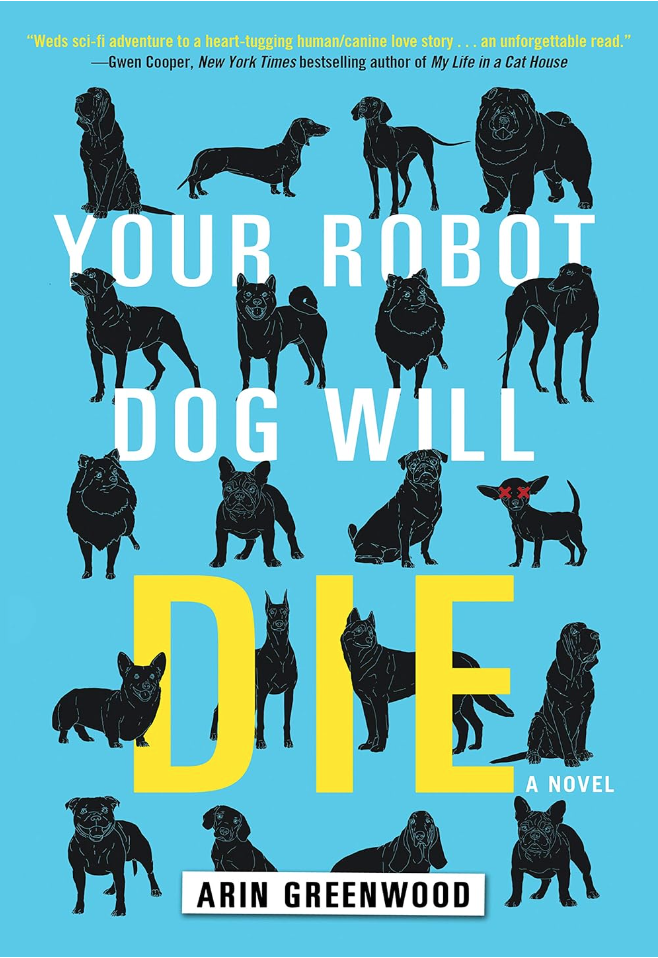
Speaking of robot dogs, here’s a WONDERFUL book about dog robots, YOUR ROBOT DOG WILL DIE, by the amazingly talented dog advocate, Arin Greenwood.
Buy it. Read it.
You’ll LOVE it!)
Basic Obedience clarifies right and wrong so your dog is safer and has an easier time getting along in human civilization. Dogs grow confident when they know how to behave in the world. Once they know how, they can relax. Obedience also strengthens your working partnership and teaches you how to communicate effectively so you can be a better pet parent. But it can be such a DRAG.
Depending on the instructor and your relationship with your dog, the training may even seem cruel or fruitless or both.
Maybe you’re a big, strong, outgoing person with a shy border collie, and your old-school instructor told you if you didn’t use prong collar and snap it, your border collie would make a fool of you. You tried it, but your dog lost heart, lay down, got snappy, got depressed, no longer trusted you—which meant you could no longer trust the dog. Everything got worse. If only you listened to your gut! You knew you needed a softer hand on this dog, but who were you to question your seasoned, seen-it-all instructor?
On the other hand, maybe you’re five-foot two and retired from a desk job with a well-muscled, headstrong, eighty-pound bully mix you just rescued (or got stuck with by a relative). You’re afraid that dog is going to pull you down, eat your cat, or worse. Your all-positive, super-woke instructor, however, says if you use a prong collar on that dog you’re a child-eating Satanist. While you’re waiting to break a hip or clean cat blood off your walls, you need to practice multiple short sessions every day. Your new life must become drilling and rewarding your scary and infuriating dog. You have to get more clever and more patient than may seem humanly possible, says your trainer, and if you don’t overhaul your life for the sake of this dog, the wrath of sainted dog ladies will befall you. Meanwhile, maybe you feel in your gut that sterner stuff—a few swift, efficient, and honest corrections—would be more humane to the dog, yourself, and your cat. But you don’t dare. Who are you to question this young, hip, sanctified, know-it-all instructor?
In either of case and in so many more, obedience doesn’t seem like the secret to sanity. But it can be. And it can even be a fun new hobby for you and your dog!
How Can You Have Fun in Obedience?
Even if you got through Basic Obedience and you and your dog are content together, why would you go back for more? Who wants more kale? You want a dog, not a robot! You want partnership and amusement and joy in your life. Agility and barn hunt and nose work and dock diving look fun! Obedience looks like a cross between marching band and the zombie apocalypse without the sound track.
For some of you, however, agility isn’t right either, (e.g. you have a bum knee, your dog drops poles or barks at you the entire time until it feels like your brain’s going to explode). Or maybe there just aren’t a lot of dog sports you both like in your area.
Maybe your only choice is obedience. Going in circles. Stop. Start. Sit. Stay. Do it again, but this time demand demanding insane precision from your dog. Don’t smile! It’s a cue! Stop praising so much! You can’t talk in the ring! Don’t move and talk like a human—you confuse your dog! But then when you act like a zombie robot, your dog worries about you. Obedience isn’t just boring—it’s crazy!
As I write, I’m asking myself why do I do obedience and why do my dogs like it so much? I’ll tell you my secret: I trained all the way to Utility Dog in my Tricks classes. That’s how. And seeing the exercises as frivolous fun taught me something serious.
First, let me tell you how I started. I quit obedience back in the 1990’s for all the Woodhouse and Monk and all-positive reasons. My sweet border collie would lie down in protest rather than endure another minute of my force-the-dog training. Of course, those were the old-school days. Now the all-positive methods work well for a bleeding heart like me and a sensitive and intelligent dog like mine.
A few quick words about “balanced” training
I have, however, had foster dogs who needed and could handle some harsh correction to help clarify not just what was desirable, but what was absolutely forbidden (e.g. biting, nuisance barking, messing in the house, knocking or pulling people down). Once the ground rules were clear, once we had clarity and trust between us (not only could the dog trust me, but I could trust the dog), we could get to work happily training our basic obedience behaviors. Compassionate correction can help you get to the fun stuff faster.
Over the years, as my dogs taught me that the kindest, sanest training is what some call balanced training. That said, there’s a lot of justified concern about what “balanced” means. Some use it as an excuse to justify heartbreaking force and coercion (see Victoria Stillwell’s “Balanced Dog Training: There’s Nothing Balanced About It”). Here’s the problem: the very word “balanced” implies equal weight on each end of the spectrum, which is not at all what I or even most “balanced” trainers actually practice.
Balance isn’t about the instructor, it’s about YOU and your dog
In order to not only accomplish the obedience training necessary to help you and your dog lead peaceful lives together, you have to find your balance. What do you and your dog need in order to achieve equilibrium in your daily life? If you’re headed home after going out shopping alone, do you find yourself dreading the sight of your dog? Then you haven’t yet found your balance.
Is your dog constantly pestering you to play or otherwise engage with them—even being naughty just to get you to pay attention—simply because they need more to do? Then get off the couch—you haven’t yet found your balance.

You might need the right obedience instructor (in person, online, or through a book), someone who’s willing to help you balance your needs against the dog’s needs. Someone who’s willing to be compassionate to both of you. Someone who’s realistic about the dog’s temperament, your abilities, and your living situation. It’s a relationship and you need a counselor.
What if it’s not “obedience,” it’s just you and your dog having fun?
Obedience, even basic obedience, can be fun!! It actually can! Just treat each element of the exercise as a game, the same way you do in Tricks or Agility.
Ask around to find out which trainers are making it fun. Call first and talk to the instructors. Look for local dog clubs. They tend to be more affordable and the volunteer instructors might even offer the best classes around.
Look for instruction that makes learning fun for both you and your dog. Even a boring class can be fun if you do a little research and experimentation. You can add fun to your routine yourself, even in class. Even if the others look at you funny.
For example, here’s a game our instructor had us play in an obedience class at Upper Suncoast Dog Training Club. Maisie and I figured it out and liked it!
YouTube is full of ideas! Here are a few:
- Fun, easy heeling exercise using your coffee table.
- Using toys to energize obedience.
- Fun little games to make heeling joyful and precise.
- Core Principles of Engagement is a great video about seizing and maintaining your dog’s attention whenever you need it–especially during high temptation and distraction–in class, at a trial, out in the world. Improves safety and social skills. Mastering your dog’s attention will save you SO much stress and will make everything more fun.
Beyond Basic, Obedience is pretty cool
Upper levels offer not only challenge, but more variety, including jumping, scent detection, and retrieval. Cool, huh? The trials just give you something to aim for. The fun is in the practice!
Open:
Below is a video of a young handler and dog acing it. If you fast-forward to 1:30 you’ll get past the familiar heeling exercises (but these are off-leash) and see the cooler stuff. If you’d like the exercises demoed and explained, watch this video.
Utility:
Here’s a video of an excellent score. If you’d like the exercises demoed and explained, watch this video.
Rally:
Rally is Obedience with a dose of sanity and a dash of fun. Learn more here.
When you feel ready—or your new friends pester you enough—you might even enter an obedience or rally competition, and you might even surprise yourself!

Categories: Lisa's Voice


 The Gloria Sirens