

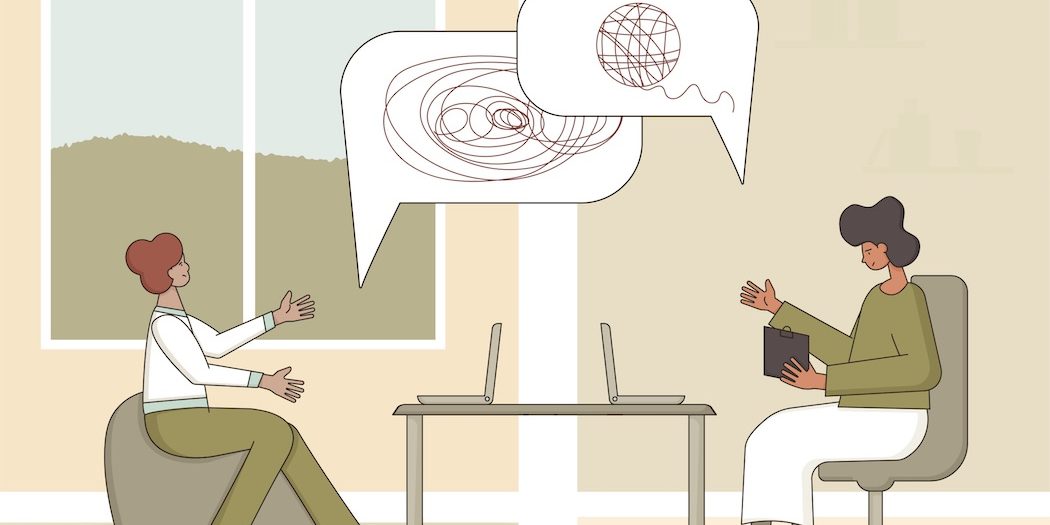
The beauty of therapy is having someone to talk with when our problems, conflicts, sadness, insecurities, and general unhappiness overwhelm us. My ideal therapist would be someone with compassion who can lead me from my neurosis into self-awareness and acceptance. When we look for a therapist to talk with, we’re also looking for someone who knows how to listen. In his essay, “The Owl Has Flown,” Sven Birkerts explains, “The therapist listens, not so much explaining as simply fostering the possibility of resonance. She allows the long pauses and silences-a bold subversion of societal expectations-because only where silence is possible can the vertical engagement take place.” Vertical engagement is the deep silence of space, the echoes of awareness that come with staying in the moment, no matter how long it lasts.
On the one hand, moments are a valuable commodity in our time-thirsty world. On the other hand, therapy is more convenient and accessible than ever when your mental health demands someone who listens. Telehealth, or online therapy, allows clients to schedule appointments with a therapist of their choice on the client’s own time wherever they are. Michelle Wakeley, a Licensed Independent Clinical Social Worker (LICSW) in West Virginia, transitioned into telehealth when Covid closed the bulk of services at the brick-and-mortar location where her office was previously located. Since then, Wakeley has engaged in online therapy with dozens and dozens of clients. Her practice began in 2013 and focuses on a variety of disorders from anxiety and behavioral issues to substance use and trauma/PTSD.
I had some questions about teletherapy, and Michelle agreed to an interview about her experience with online therapy and telehealth. Here’s what she had to say.
Q. How hard was it to transition from in-person client contact to online client contact? How is it working out today?
I had some previous experience delivering therapy online, so switching from in-person to online therapy was fairly easy. The criminal justice system, the military, and some private practice therapists had been doing telehealth for years. The fact that it happened in response to a world-wide public health emergency was the difficult part. Telehealth transformed overnight into the standard method of delivering therapy services out of necessity, in a time when human connection and psychological help was in high demand. Therapists and clients alike rapidly adapted to a new normal, with the help of support staff, software developers, and other people behind the scenes. For example, I offer Eye-Movement Desensitization and Reprocessing (EMDR) therapy, which was regarded as an in-person-only therapy until the pandemic. The research now shows EMDR to be equally effective when administered through telehealth. Play therapy and art therapy took similar leaps. Group therapy and couples counseling also came along. I believe it was Plato who said, “our need will be the real creator,” which we often translate to “necessity is the mother of invention,” and that’s certainly the case with telehealth in the modern era.
Not only has it worked, it’s revolutionized how we provide care. It has removed barriers to treatment for some, become a preferred means of therapy for others, and really broadened options for all persons seeking therapy services. Telehealth eliminates the need for reliable transportation, childcare or other caregiving alternatives, excessive time away from work, and other resources that have historically prevented people from getting needed care. Even if potential clients have these resources handy, many still choose telehealth to have a wider selection of providers, or to save time, energy, and money.
Q. What benefits are there to online therapy? Are there any disadvantages?
The most obvious benefit is the one that drove us all online in the first place—telehealth mitigates health concerns that are inherent with in-person interaction. Now that COVID is more under control, it’s no longer on the forefront of most of our minds. For persons with compromised immune systems, or anyone caring for someone with serious medical issues, this remains a big deal.
With telehealth, you have access to a much larger network of providers, your choice between them, and greater options. Some clinicians have gained multi-state licensure and expanded their reach beyond state lines. Some started offering night and weekend availability in ways they never could before. There is even a big push for interstate licensure, which would dramatically increase the number of providers in underserved areas with massive waiting lists, while decreasing the saturation of providers occasionally seen in large cities. Oftentimes, people are seeking therapy for a specific reason, like OCD, disordered eating, or PTSD, in which they are also seeking a particular type of therapy, and there simply aren’t qualified providers in their immediate area. We see this a lot in WV since we are a rural state with a lower population and a high rate of health issues. Several of my clients with Opioid Use Disorder were accustomed to driving several hours each way because our office was the closest place providing the life-saving treatment they needed. Almost all of my clients continued online after the office opened back up, because it just made more sense to them, and they didn’t feel they were sacrificing care quality.
Telehealth cuts out undue stressors associated with just getting there and back. We have a few multi-year road projects that impede traffic flow, and I’m sure my clients are happy to not have to deal with that stress. Our winters get pretty bad here, and I think even with local travel a lot of people enjoy that they can attend therapy while snuggled up with their pet rather than risking the infamously icy roads. I view therapy from the context of the person in their environment, so I love getting to see their pets and different living situations. These details that I don’t get from clients when they are in a curated office setting really add a lot to my understanding of what life is like for them.
I’ll add that in small towns, where everyone knows everyone, it may be especially desirable to seek telehealth since the client won’t have to worry about seeing people they know. As far as we have come as a society, shame and stigma around mental health still exist, and rank pretty high on the list for reasons people don’t reach out for help. Telehealth can create some distance and sense of safety that promotes really opening up and trusting the process. I sought online therapy during the pandemic, and that was partly motivated by knowing I could connect with someone that wasn’t a close colleague.
It’s important to point out that online therapists and in-person therapists are no different in their required education, training, and experience. We also have the same standards for security, confidentiality, and privacy. The qualifications and protections are the same no matter the location. In fact, a lot of therapists offer a hybrid model, where they both meet virtually and in-person.

Q. What are some tips on finding an online therapist who is a good fit for me? What should I look for?
There are a number of in-roads to finding an online therapist. Most popular are online directories, and your insurance company, if you have one. I have a profile on Psychology Today because it’s the most well-known directory in my area. I signed up for Open Path Collective because they offer therapy for a set price of $40-$70 per visit. I am listed on Therapy Den because I appreciate and respect their attention to cultural sensitivity. Simple Practice is my Electronic Health System, and they offer a public directory of clinicians. Each directory allows you to filter your search based on demographic information, issue areas, specialties, populations, level of experience, cost, insurance coverage, availability, etc. to create a list of providers that might be best for you. You can use these directories whether you have insurance or not. If you have health insurance, you can call or check their website to locate an in-network provider.
Once you find a therapist you’re interested in seeing, you can verify their license with their respective board and check for complaints filed against them. You then call or message them to schedule an appointment. Some providers have online scheduling available. I have heard tales of frustrations from clients about calling around for therapy with no response, and that is an unfortunate and uncontrollable possibility. Try not to let it stand in your way. There is surely someone that wants to meet with you as much as you want to meet with them.
As far as warnings, I’d encourage clients to not use big box telehealth therapy companies. They do hire licensed therapists, but there have been a few lawsuits filed recently with claims of these companies selling protected consumer information. They also pay very poorly, which is more likely to result in frequently having to find a new therapist.
Regarding restrictions, some persons may be better suited for in-person care, including young children, persons with severe and pervasive mental health issues, persons with severe developmental disabilities, and persons with safety concerns. Persons who lack safety and privacy in their immediate environments, including persons in domestic violence situations or persons who are co-habitating in multifamily or group settings, may also prefer to go to an office for therapy.
I wouldn’t worry too much about whether online therapy will be a good fit for you, assuming you do not have pressing safety or privacy concerns. Your therapist will likely be pretty upfront if they think you need another type of service and offer referrals.
Some therapists offer free 15-minute consultations so you can get a feel for them before you pay. That might be a good place to start.
Q. How expensive is online therapy? Do insurance carriers cover online therapy?
Online therapy is the same cost, or cheaper, than in-person therapy. Every insurer, including Medicaid and Medicare, covers online therapy currently. Some offer reduced copays. The only way for you to know for sure what your options and costs will be is to reach out to your insurance company and the therapist directly. Most therapists list their price on directory profiles or their websites. Groups like Open Path Collective market lower rates. If you are uninsured, you are now entitled to a Good Faith Estimate under the No Surprises Act that clearly informs you of your anticipated out-of-pocket expense. Again, having access to a broader network has benefits, including the ability to shop around.
Q. Is there an average length of time a person is in therapy? Can I talk to a therapist just once? What about emergency drop-in therapy?
There’s never a set number of times a client is required to attend therapy, unless of course they are court-ordered or have some other third-party dictating how long they must attend.
Otherwise, the fit between the therapist and the client, the presenting issue, and the therapy model set the stage for how long someone might be in therapy.
You can absolutely attend just one therapy session. People commonly attend once and move on if it’s not a good fit or they have second thoughts. There is nothing wrong with that. I liken shopping for therapy to shopping for a shirt. If I’ve determined that in order to interact in a society I need to be clothed, I’m going to need a shirt. I’ve purchased so many shirts that I thought were going to be a good fit and ended up not liking them, or over time I grew out of them, or the reason I needed them changed. That’s okay. That shirt isn’t a good fit for me. I can’t run around naked, so I keep shopping. In the case of buying a shirt, I actually really like shopping. I like trying things on or imagining how the shirt might add something to an existing outfit. I urge folks to approach shopping for a therapist with the same open mind and curiosity.
There are also times when the presenting issue is very narrow and a solution-focused single session is all that is needed, as may be the case if you simply want some feedback regarding taking a new job or moving to a new town. More often, therapy is an unfolding process in which changes occur gradually over multiple sessions. Cognitive Behavioral Therapy (CBT) is one of the most well-known therapy models, and it is typically viewed as a short-term therapy lasting 12-20 sessions. It can extend indefinitely if there is more work to be done or if the client benefits from keeping in contact every so often to maintain gains. Similarly, EMDR can be a very quick therapy with only a handful of sessions if the client was in a good state of health prior to a single-incident traumatic event and can extend to be a long-term treatment based on the needs of the client.
Most therapists will offer an additional session if you are having a rough time and need to be seen sooner than your next scheduled appointment. In certain therapies, like Dialectical Behavioral Therapy (DBT), check-ins and crisis calls are an expected part of treatment. If you are having thoughts about harming yourself or someone else, you may be encouraged to call, text, or chat with an emotional support line or the National Lifeline (988) or go to your nearest hospital’s Emergency Department for immediate assistance—which is the same protocol we follow whether in-person or online. If you’ve completed therapy and want to touch base because something new has happened, contact your previous therapist. It’s common for clients to request a “booster” session or to embark on a new leg of their therapy journey.
Q: In his essay, “Loss of the Creature,” Walker Percy appeals to an imaginary therapist, saying: “I have nothing else to offer you but my own unhappiness. Please say that it, at least, measures up, that it is a proper sort of unhappiness.” What kind of affirmation do you think Percy is looking for?
Ultimately, the thread that runs through all of us is the desire for acceptance and belonging. It is a primal need to be included in the herd, or else we may perish. We wish to be seen and heard by others as if we are significant in some way. The social work credo is to: Do what you can, from wherever you are at, with whatever you have. There are times when bearing witness to a life and acknowledging one’s existence is the most good I can do. You are good enough to exist here.
In seeking therapy, we are seeking connection and belonging. With mental health, most of us are coming in with our own inner critic and the voices of others that have minimized or outright dismissed our experiences as something that SHOULD NOT bother us the way it does, but IT DOES. The beauty of therapy is the unyielding presence of a supportive and non-judgmental person that is skilled at understanding the human condition and how to respond to it effectively.
It reminds me of a since-passed loved one of mine that saw a therapist they regarded highly, yet they said, “She keeps trying to make me better, and I just want to be happier with the crazy I am.” She did get better, and she stayed “crazy,” and those are not mutually exclusive.
Categories: Sister Sirens


 The Gloria Sirens
“You are good enough to exist here.” Yes!
LikeLiked by 1 person