


On a recent Sunday afternoon, Greg and I took a drive along I-68 toward Cumberland, Maryland. The weather was perfect, high winds blowing puffy clouds across a perfectly blue sky. The state of Maryland is shaped kind of like a meat cleaver, its handle a trail of mountains that reach elevations of up to 3,000 feet. Our final destination, ninety miles from home, was the 1812 Brewery, a farmland venue on the outskirts of Cumberland, where George Washington once bivouacked with his troops, to attend an early celebration of 4/20 hosted by Grow West Cannabis Company. The event flyer promised food trucks, live music, craft beer, and good vibes, as well as artisan booths and cannabis companies giving away stickers and other swag.

One of the bands was called Jiggle Billy after a character from Aqua Teen Hunger Force, an action figure modeled on a stereotypical moonshiner equipped with night vision goggles for no apparent reason. Heading to a festival sponsored by the cannabis industry felt almost as surreal. Only forty years ago, in the Texas of my youth, getting caught with a gram of weed, or about two joints, was a felony crime punishable by up to two years in state prison. To see the zeitgeist shift so radically in my lifetime is a revolution of tectonic proportions. Cannabis possession is still a gray zone that can get you locked up in certain states (I’m looking at you, South Dakota, Idaho, and Louisiana).
It’s the twenty-first century, and twenty-four states have legalized recreational cannabis for adult use, along with DC and Guam. The first time I visited a dispensary, Broadway Cannabis Market, in 2019 in Portland, it felt like a crazy risk to walk blatantly into a marijuana store. I was in town for the Associated Writers and Writing Programs Conference, and the dispensary was right across the street from the Oregon Convention Center.
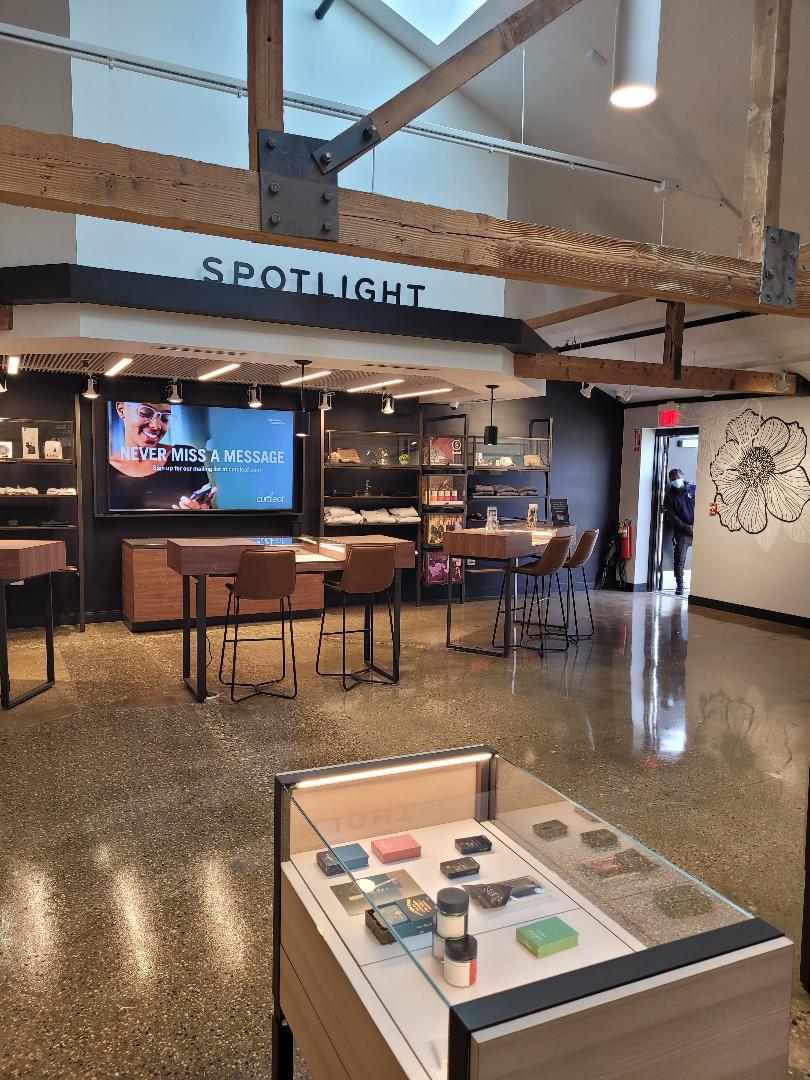
Some aspects of that first retail cannabis experience have been replicated no matter what city I’m shopping in, Portland, or Seattle, Vegas, Kansas City, Chicago, Cumberland, even Sturgis, Michigan. All physical dispensaries have a lobby area where a valid driver’s license or ID is required to enter further. In general, the retail spaces I’ve experienced are a mixed vibe of industrial with urban wild-flower accents, lofted ceilings, steel beams, railroad tie planters growing daisies, angled walls with thick ivy drapes, low slung Danish chairs in waiting areas while your order is processed.
Broadway Cannabis Market in Portland was the only shop that had edibles, cartridges, and other goods stacked on shelves for patrons to handle. There was also a “flower” counter, with buds visible in large glass jars on shelves. Attendants weighed out portions on elegant chrome scales. Purchases were cash only, and an ATM was available. Since then, some dispensaries have begun to accept debit cards with added courtesy fees.

In all the other dispensaries I’ve visited, patrons do not touch products. Instead, there are glass cases like jewelry store cases, or museum cases where artifacts are laid out and labeled. The cases display flower brands, gummies, cartridges, tinctures, beverages, baked goods, even chewing gum. The salespeople are congenial, and you’ll be assigned a personal shopper if you didn’t pre-order. Salespeople are happy to make recommendations, and you’re sure to hear the stock phrase, “Good choice. Good choice.” Each state provides licensing for producers, though some brands are nationwide like Wanabrands or Leafly, and my favorites, Mindy’s Edibles. Since each state designs their own tax structure, prices vary wildly. We experienced bargain deals in Sturgis, Michigan, but sometimes you get what you pay for. The dollar-a-piece suckers melted within a month in their packets, and the gummies looked homemade. On the other hand, DC Dispensary and Weed Delivery added a free grape gummy, a perfect square, to our order, and it was the best quality.

Buying cannabis products in DC felt as shady as an old-fashioned drug deal. Instead of visiting a physical retail space, we registered with DC Dispensary and placed our order online. You cannot legally buy cannabis products in DC; they come as a “gift” when purchasing a sticker or trinket, like the fake plastic Hot Wheels car that came with our flower and gummies. We were given the total cost of the transaction, which had to be paid in cash, and the time and place to meet on the street outside Motto, the micro hotel where we were staying. At the appointed hour, well after dark, a car pulled up, and a young woman got out and met me on the sidewalk, took the cash, and handed me a brown paper bag. A cop car was parked down the street, but no one seemed to care. We not only got a little blue car, we got the cannabis products we ordered, and the amazing grape gummy as a freebie.
For the past couple of years, my partner, Greg, has had a medical marijuana card because he has Parkinson’s. He uses marijuana to improve the quality of his sleep, which is otherwise restless, full of movements and shouts as he acts out the scenes in his dreams. The medical dispensaries in West Virginia are similar to adult use dispensaries in other places: modern architecture, clean and spacious with an ambiance of therapeutic nature.
Greg is a latecomer to cannabis use, but he doesn’t mind joining me on my quest to visit recreational dispensaries in other states when we’re traveling to visit family, or for business or pleasure. The reason he doesn’t mind visiting recreational dispensaries is because he says they have the best, non-gendered restroom facilities. He’s a stickler when it comes to evaluating public restrooms, using a rubric that includes cleanliness, accessibility, and general aesthetics. Adult use dispensaries, he claims, have restrooms as well-tended as those available in a five-star hotel’s lobby.

in a Curaleaf in northern Chicago.
Categories: Health, Living, Suzanne's Voice


 The Gloria Sirens
Loved this! Though I’m a Vietnam vet, and afterwards lived in Berkeley for 10 years, my interest in and tolerance for drug use, especially smoking weed—I hate smoking—has been minimal. That is until recently, when I had a stretch of sleepless nights. A friend suggested edibles, which are easily available at the many “420” shops here in Olympia WA, and I was introduced to the astonishing variety of cannabis consumables being marketed, and the capitalist culture of that enterprise. At the same time, I’m reading Jonathan Haidt’s “The Righteous Mind, “ all about how we arrive at our moral judgements—remember all the propaganda and criminal-legal nonsense about the evils of marijuana, the “gateway drug”? Yes, still out there, but where there’s money to be made, American minds can be changed, and a good night’s sleep is only a gummy away!
LikeLiked by 2 people
I haven’t read Haidt, so thanks for bringing the book to my attention. I’m a pothead from way back, and the legal cannabis industry is not something I would have predicted, though why not? As you note, capitalism will appropriate anything.
LikeLiked by 2 people
James, I read The Righteous Mind too–it really swayed the way I see everyone in this political climate. Great book! And yes, I’ve been frankly horrified by the rapaciousness of the cannabis industry. We don’t know enough about the physical and mental health ramifications, and they push it on unsuspecting consumers, especially young people, like it’s a cure-all. Stodgy old doctors are idiots! Cannabis is magic! You have pain? Smoke this. You can’t sleep? Smoke this. You need to focus? Smoke that. Coughing? Ignore it. Anxious? Smoke more. Nauseous? Smoke even more. Depressed? Keep smoking . . .
LikeLiked by 1 person