


When I type, my fingers fly across the keyboard making musical clicking sounds. My task this time is to transcribe an eight-thousand-word printed manuscript into a Word document for editing. My fingers are long and well-practiced, lo these many years. Speed and accuracy were the twin standards for winning a typing award back in high school timed competitions.
With the printed manuscript beside me on the desk, I assume my typing posture, leaning forward in my office chair with spine straight, elbows tucked close to the waist and forearms extended. As I read the manuscript, words flow into my mind and out the tips of my fingers. My posture is a correlation of the body and the gesture that would have made Foucault proud.

When I was much younger, I also typed, but the rest of my body was a stranger. When we’re young and healthy, some of us take the body for granted, or at least I did. My body gave me so little trouble, I felt like Emerson’s transparent eyeball, out and about in the world without a pain or distraction. I relied on my body to function well without too much tinkering or maintenance so I could spend my time thinking about important things like friendship drama, partying, boys, clothes, make-up, concerts, my part-time job, and the books I was forever reading. Sure, I was also going to school and rebelling against my parents, but at least I felt healthy doing it.
I can say without reservation that my relationship with my body has changed. I’ve discovered surprising things, like I was born without a right tube and ovary. I did not know this until I was twenty-five and undergoing a tubal ligation. After the birth of my third child, I scheduled the surgery. I was half-awake on the operating table, and the OBGYN could not find all my parts. He said, “She’s pretty smart. Let me ask her. Suzanne, has a doctor ever mentioned you’re missing your right tube and ovary?”
No, no, they hadn’t. Why, I asked my OBGYN, why did I get pregnant so easily and often? He shrugged. “The body compensates. Your other ovary could have ovulated every month. With only one tube for the sperm to travel, your chances actually doubled.”
Which was way better news than I received several years later at the youthful age of thirty-eight. A slight discomfort in my chest led me to undergo an EKG, which the technician repeated ten times because the results were off the charts. As my current cardiologist, Dr. Tingler, could tell you, I was born with hypertrophic cardiomyopathy (HCM), or a thick heart wall, a condition that’s genetic and congenital. Fortunately, I live with few symptoms and see my cardiologist every year. Sometimes if I forget to drink water and get dehydrated, my heart beats in my chest like a washing machine out of rhythm.
The missing ovary and wonky heart are old news at this point, but my body can still surprise me. I feel more like Kurt Vonnegut’s “meat” most days than Emerson’s imaginary eyeball because age has gifted me a few aches and pains, and moles with lucky whiskers growing out of them to signify wisdom, according to Chinese lore.

When I think of literature and the body, William Blake also comes to mind. He warned in The Marriage of Heaven and Hell about relying too much on reason and the “five Senses” at the expense of the imagination. Reason is only the “bound or outward circumference of Energy,” while imaginative Energy is from “the Body” and the real “Eternal Delight.”
Unfortunately, our meat can fail to be a delight in the short term, not to mention the long term. In last week’s Siren post, “Ow,” by Diane Masiello, she describes the delicate balance between the body and the mind and how pain disturbs it. The suffering body is drawn in tender terms, though as Diane points out, the real shocker is “how mentally debilitating…physical pain is.” She writes that pain, its reprieve, and “the fear of when it will return is interfering with my ability to think. For a writer, could there by anything worse than not being able to put a sentence together because of the incessant throbbing in her bones?”
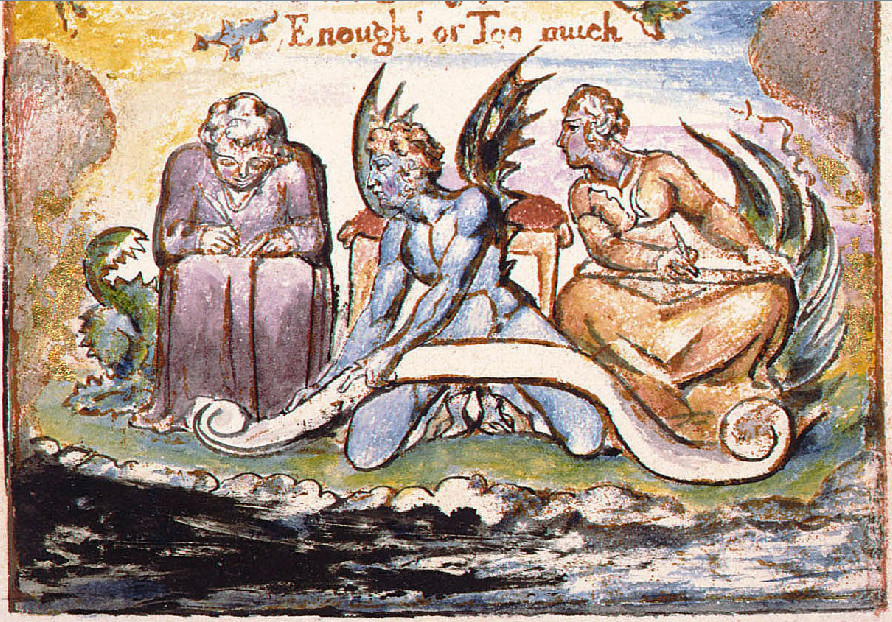
Unwanted pain, from wherever it arrives, can destabilize the mind-body connection to various effect. Physical pain is subjective, each of us having a threshold from the most sensitive to the least. Some bodies are stoics, like the character Cash in Faulkner’s As I Lay Dying. When Cash breaks his leg on the journey to Jefferson with his family, they throw him in the back of the mule-drawn wagon and proceed down the rough dirt road. Poor suffering Cash, who is pale and sweating, says, “It’s just the bumps. It kind of grinds together a little on a bump. It don’t bother none.” Things gets worse when the family pours concrete directly on Cash’s leg to set it, when the sun bakes the cast, when Cash’s toes turn black, and, for the kicker, when Peabody, the doctor, finally strips off the concrete and removes skins, he asks Cash, “Does that hurt?”
“‘Not to speak of,’ [our stoic says] and the sweat big as marbles running down his face and his face about the color of blotting paper.”
I cringe at the description because Cash’s suffering seems too much to bear. As Diane points out in her essay, “Ow,” what we can learn from pain is empathy and compassion toward others whose bodies are failing, sometimes in the most painful ways. We’re all Vonnegut’s meat sooner or later. The least we can do, even in a Transparent Eyeball stage, is offer understanding and support.
And so it goes. I’ve accepted that my body can no longer turn cartwheels, but I can still type like a pro, even better than in high school when errors were harder to correct. We do what we can, hopefully with kindness. The surprises a body can throw at us, they don’t stop coming.

Categories: Health, Living, Suzanne's Voice


 The Gloria Sirens
The story is beautiful
LikeLike
Thank you. Nice typing.🙂
LikeLike