
In the spring of 1979, I was enrolled in a Government Class required for graduation at Greenville High School. It was the Dazed and Confused era of teen life in Texas, and some of us upperclassmen embraced that life on principle. We were nascent adults, working part-time and paying our way in the world, liberated by half-ass freedom and a belief that adulthood would be even better. One day, our instructor, poor guy, Mr. (Kenneth) Linden, invited a couple of police officers to speak to our class. During the question-and-answer session, a popular party girl, one of my classmates, raised her hand. She had long, curly hair and a slight lisp. She asked, “My question is, why do the pigs harass kids?”
I was stunned and feared she was in big trouble. My eyes were trained on the gray-haired cop behind the podium, who resembles Joe Manchin in my memory. He looked back at us with steely blue eyes and said, “Go ahead, call me a pig. I don’t mind. Pig stands for pride, integrity, and guts.”
The cop’s response stuck with me harder than any lesson Mr. Linden ever taught. The answer was a deflection from the real question, but what do you expect from an authority figure? My political sensibility was just developing. When guys called me a “women’s libber,” it felt like a compliment. I wasn’t a practiced critical thinker, but being a reader exposed me to texts about social justice, and the human suffering caused by injustice. My sense of history was still adolescent and absurd. The World Wars seemed like ancient news, and I didn’t remember when JFK was shot because I was a year old when it happened.
The other memory I have of Government class involves three high school exchange students from Iran, a young man, and a second young man married to a female student. They joined our class when the second quarter began. Then one day they were gone, and I never saw them again. I don’t remember the young woman’s name, but our desks were side by side. She wasn’t fluent in English, but we engaged in communication. I was curious about other people and worlds and thought I might learn something from her. Her sudden absence went unexplained and bothered me. In retrospect, she, along with other Iranian exchange students in the U.S., were likely recalled to Iran. In spring 1979, the Shah fell from power and fled the country. Ayatollah Khomeini became the supreme leader of the Islamic republic, and relations between the U.S. and Iran took a turn for the worse. Later in 1979, armed college students in Iran took over the U.S. embassy in Tehran and made hostage of 52 people, which began the Iranian Hostage Crisis.

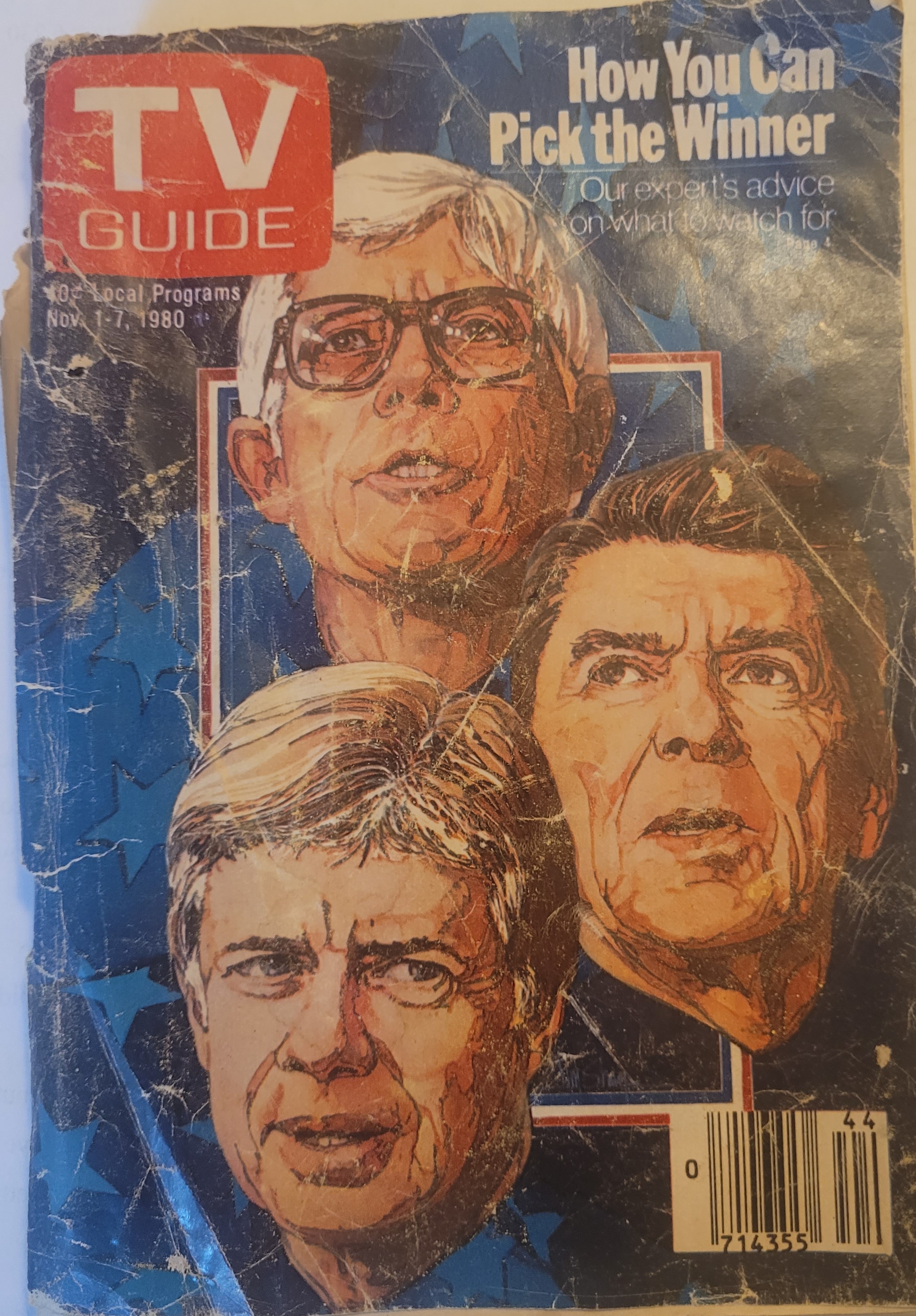
Cue February 1980, when I turned eighteen and became a legal adult, only three months away from high school graduation. It felt like kismet that it was a presidential election year. Voting was important to me because I knew women had to fight for the vote, and it had taken more than one hundred years before all women had the right. I went to the courthouse and registered, though I don’t remember if I registered as a Republican, Democrat, or Independent. I do remember how I ultimately voted, and what I saved to commemorate the occasion, Issue #1440 of TV Guide, November 1, 1980, its cover featuring images of the three presidential candidates: President Jimmy Carter, challenger Ronald Reagan, and third-party candidate John Anderson.
The Iranian Hostage Crisis was front and center news during the leadup to the 1980 presidential election, and Walter Annenberg, president of TV Guide, waded into the fray with a commentary in Issue #1440 called, “The Presidency and the People.” He took President Carter to task for negative campaign ads that cast Reagan as “a warmonger with simplistic, antiquated economic ideas who would divide the country into antagonistic racial, religious and geographical factions.” (I wonder what Annenberg would think of political ads today, yikes!) He then accused President Carter of appearing weak on the international stage and argued that “diplomacy must be backed by strength” of the military kind. He insisted that our social problems could not be “quickly dissipated by Government handouts” or social programs. We needed to pick a president who would draw a line in the sand. The hard-edged rhetoric and conservatism won out, and Reagan was elected a few days later by a landslide of 489 electoral votes.
I was one of the voters who cast a ballot for Reagan on November 4, 1980, influenced by my parents’ political views, media reports, and Reagan’s reassuring and charismatic persona. The hostages were released by Iran hours after President Reagan’s inauguration, which is part of his legacy. I don’t know if I’d vote the same way today, but that’s one of the beauties of presidential elections. They happen every four years. A citizen like me gets chance after chance to develop their political views and align with a candidate for president who represents the citizen’s values and interests, like social justice and social well-being.
At this late date, I identify as a flaming liberal and radical feminist. Before President Biden withdrew from the current election campaign, I told everyone I was “Ridin’ with Biden.” I don’t have a new slogan to put in its place, though I support the bid of Vice-president Kamala Harris and anticipate the announcement of her running mate. I feel hopeful and excited to vote in 2024, almost as excited as I did the first time around in 1980. Voting never gets old, only voters do. May every eligible citizen register and exercise their right to vote as long as our Democracy exists.

the cliffhanger was revealed.
Categories: Living, News, Suzanne's Voice


 The Gloria Sirens