


For the past twenty-five years, my mother has been manifesting her dream to build a Christmas wonderland farm. On five acres on the outskirts of Dallas, just across the Fannin County line, there are three outdoor buildings and a gazebo devoted to Christmas year-round, not to mention strings of lights and decorations in the surrounding woods, and on the house and paths around the property. Each of the outbuildings has a unique history and a name, the Christmas House, the Rainbow House, and the Lighthouse. The Christmas House was established first, in 2000, when my mother, Shirley Ann Alsip Chapman, began her project to build a Christmas wonderland like Tiny Town in Easley, South Carolina.

I understand her inspiration. You’ve probably never seen anything like Tiny Town. I know my family hadn’t when we visited it one night in the early ’90s when we lived in South Carolina. Tiny Town is a makeshift Christmas village in the country, and it’s free, though the owners accept donations. Visitors tour a rambling ring of wooden sheds and showcases built around a blazing central fire fed by castoff wooden spools. In the sheds and showcases, behind plexiglass barriers, old, new, and random toys are posed in weird holiday scenes, like a battered one-eyed doll sitting at a kiddy table for Christmas dinner with other toys, including a brand-new Barbie, with empty soda bottles of all kinds on the table, and a plastic Christmas tree decorated with old key chains. Walking past the displays, my mother and I were captivated by the strange scenes. Tiny Town is curated to be an experience. It’s outsider installation art.

Before my mother began her Christmas farm project, she had to collect contents to fill the outbuildings. She’d always been a collector of things like Avon bottles, cut glass, and chess sets. Her focus became glass Christmas houses that lit up, sometimes played music, and sometimes contained animated figures you could see through the tiny windows, like gentlemen and ladies dancing on a circular track. She bought glass houses everywhere and received many as gifts. I estimate the collection to number five hundred. She also collected Christmas trees and ornaments, Christmas brooches and quilted wall hangings, Christmas bears with their “year of birth” embroidered on one paw, nutcracker figures, Christmas circus cars, and a train set which is stationed in the Lighthouse, established in 2012. As her collection grew, she needed more space, and so the Christmas farm expanded.
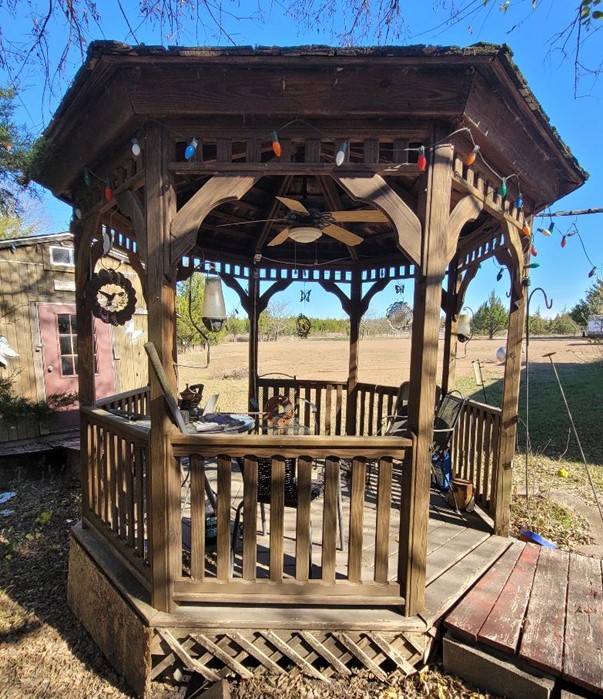
My mother’s drive to bring something new into existence to share with the world is an inspiration to me. For years, she hosted holiday gatherings in winter, fall, and spring, inviting people from church, friends, and friends of friends to tour the Christmas farm. At Halloween, she made a haunted trail in the woods. In the spring, there were Easter egg hunts. And year round, visitors were amazed by the collections in the Christmas House, the Rainbow House, and the Lighthouse.

This year, health concerns prevented my mother from hosting a Christmas gathering. She worries about what will happen to her collections when she downsizes in 2024. She’d like the collections to go to a good home, to someone who wants to keep the glass houses together and displayed. She envisions the collections in a party barn that’s a venue for events like birthday parties and weddings.

I spent my last visit taking pictures of the Christmas farm because it’s living on borrowed time. The Christmas farm reminds me not only of Tiny Town, but of other installations created by dreamers, like House on the Rock, built by the architect Alex Jordan in Spring Green, Wisconsin, and the Mystery Castle, built by Boyce Luther Gully, in Phoenix. Like other visionaries, my mother is a builder, imagining and creating a unique space for others to experience. She’s ready now to pass on the torch, or the builder’s dream, as I see it.
Categories: Art, Suzanne's Voice


 The Gloria Sirens