

I’m teaching an Advanced Placement course in writing this year for high schoolers, and one of their tasks is to write an argument essay responding to a prompt. If I wanted to write a prompt based on our summer excursion, it would be this: To what extent is family travel more about connecting with loved ones than about seeing and appreciating the history and culture of the places we visit?
After touring Naples, I might have argued that those things were mutually exclusive. Our tour of Postiano, Sorrento, and Pompeii would prove me wrong. But first, there was Sicily.
After spending three days on the cruise ship, even the kids felt it was time to go ashore. I had cancelled the tours we booked earlier, but there was still transportation available to some sites. We chose to spend a half day in Taormina, Sicily. We had no idea what Taormina was like, but we thought it would be good to stretch our legs.
We boarded a small bus, and about 1/4 of the way through the drive, we heard a splash and a shout. The back of the bus was a few rows behind us, and sitting there was a man soaked with brackish water. Evidently, our bus had a bit of a mold problem, and when it turned just-so, the air-conditioning condensation spilled all over him. His family yelled, “Stop! Stop this bus! We need a new bus!” but our driver only sped up. It was awful for them, and the rest of us felt helpless. No one had any towels, our guide was completely unsympathetic, and the family was furious. We were only a few seats in front of the doused man, so by the end of the ride condensation began leaking on us, too. It was not an auspicious start to our first shore excursion of the week.

Once we arrived in Taormina the beset family set off to find a bathroom and a new shirt for the man. We also found a restroom where we could wash off the water. Then, we set off to explore. The city was absolutely delightful–rustic buildings, lots of flowers, cobblestone streets, open walkways, lots of stairs, shops, eateries, and all with a view of the Mediterranean. We stopped to do a little more shopping, as we found a lovely citrus-themed store with dishtowels, soap, candies, fans–everything a souvenir shop should have.
We visited a few churches, and I said my rosary. When leaving we heard someone yell, “Signore! Signore! Doctore!” We turned to see a middle-aged man rushing up to us with a young woman following. We immediately started to worry that we were being set up for a theft or grift, because we’re suspicious like that. When the man reached us, he spoke directly to my husband, saying a name like a question. My husband shook his head. The young woman with the man spoke and understood enough English, and my husband spoke and understood enough Italian, that they were able to figure out that the man thought my husband was an old friend of his. The man pulled up a photo on Facebook and showed it to my husband to prove that he wasn’t lying. The man in the photo did look incredibly like my husband, and it turned out they’re both doctors!
I was really impressed at how well my husband conversed with the man and his daughter. He’d been studying Italian all year in preparation for this trip, and he comported himself so well. He’s applying for Italian citizenship, and as he spoke to the man I could see us sitting in a cafe, him chatting with an Italian friend, and me just quietly smiling and enjoying the countryside, not having to be the social one or the one who keeps the conversation going. It was a delightful fantasy.
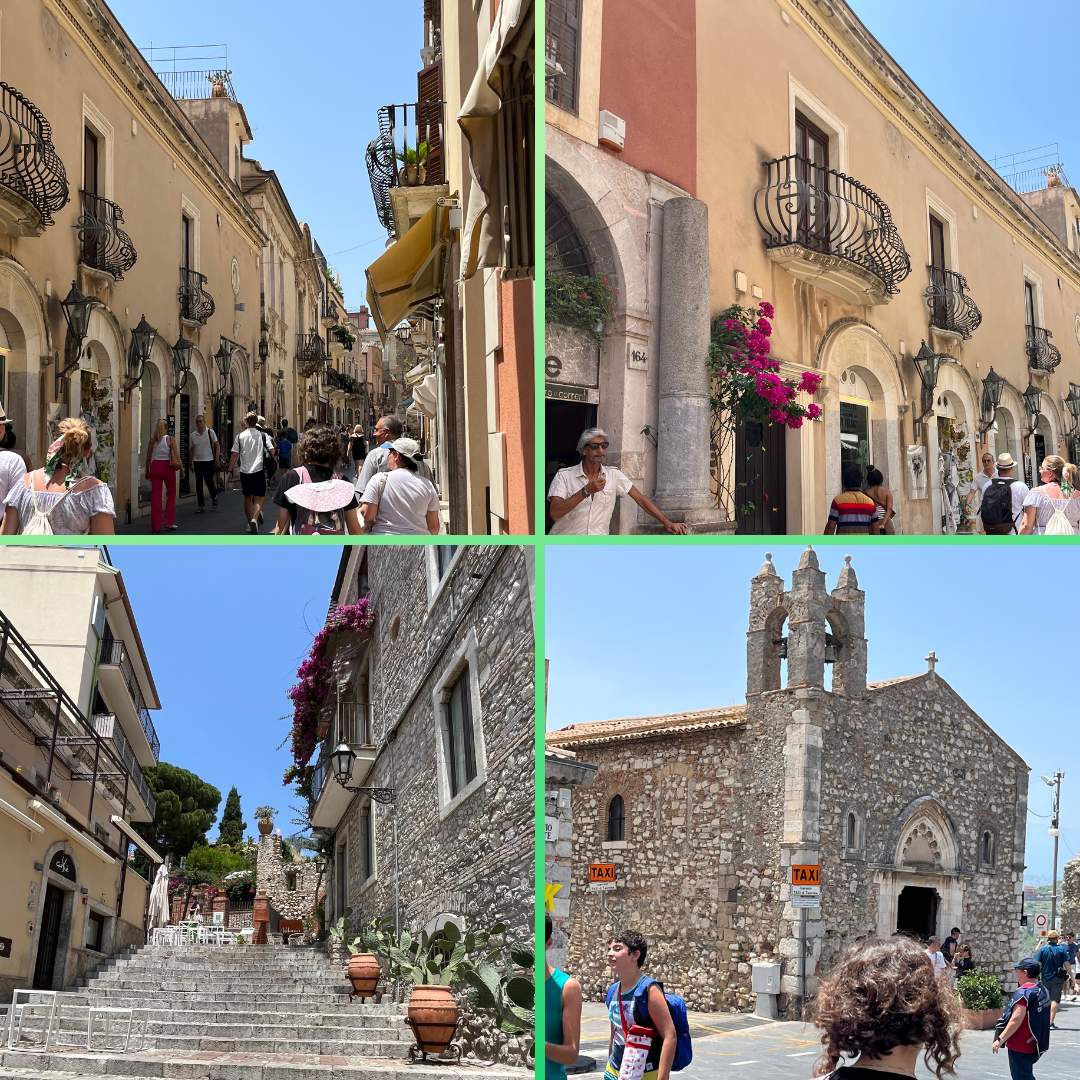
“So, how many more churches are we going to have to see?” The question broke into my daydream.
Clearly the “seeing and appreciating the history and culture” part of the day was over. If I wanted to maintain family connection, it was time to do something else.
“We have to be at the bus in less than an hour. Let’s grab a snack and then start heading back,” I replied.
We found a little cafe. My husband ordered bruschetta, and the flavors were beyond anything I had ever tasted before. The tomatoes were perfect, the basil was incredibly fragrant, and the bread was perfectly crisp. My younger daughter dug into that meal like she hadn’t eaten in weeks (after her illness she had been very careful of what she ate). My older daughter was also enjoying it so much we ordered more. We almost didn’t have time to finish before we had to head to the bus, because all we wanted to do was continue sitting in that cafe, chatting and people watching, laughing about the mold and Dad’s new Italian friend for awhile more.
We got back on the moldy bus for the ride back to the ship. I made it clear to everyone that we had to get a good night’s rest because the next day was a day I had been envisioning for my older daughter’s senior trip for many years–we were going to see Pompeii!
My older and younger daughters both began taking Latin in 7th grade, and the book they use was about life in Pompeii. They would spend hours laughing and joking about the story; my oldest really didn’t want it to end because she didn’t want to read about the volcano that destroyed everything. Their middle school teacher had journeyed to Pompeii often; their high school teacher majored in archaeology so knew a lot about Pompeii as well. For me, this shore excursion was all about bringing into their real, lived experience something they had studied and heard about for over five years of their lives.
As it turned out, Pompeii was the last stop on our tour because our guide felt that we would have more shade at the end of the day. The first part of our day was a tour of the Amalfi Coast with stops in Positano and Sorrento. Though when I booked the excursion I expected to just be along for the ride for that part, it was by far one of the most exquisite days of our trip. Our guide was fantastic, telling us all about history and legends. Driving along the beautiful Amalfi coast we saw buildings built into the mountains, and passed an island that was supposed to be home of the Sirens from the story of Odysseus (and from, you know, this blog).

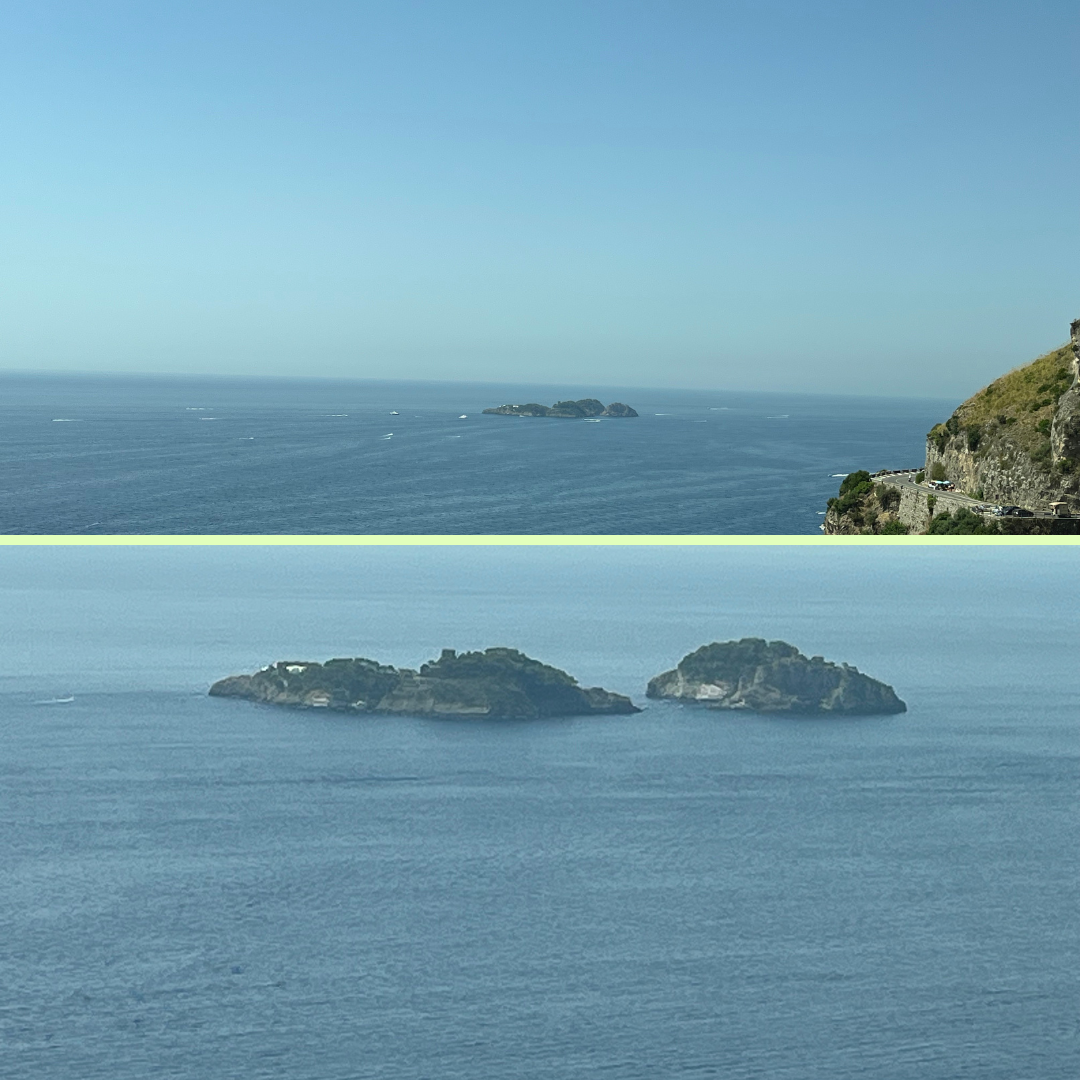

When we arrived in Positano we were told we’d only have a short amount of time to look around, and it was hot, so we simply wandered to a cafe. We were looking for a very specific type of pastry that we were told in Sicily the day before we could only find near Napoli. It’s called Sfogliatella, and it’s a crisp, layered pastry, shaped like a lobster tail, with a sweet filling made of ricotta cheese. We found it in the bakery, and were beyond thrilled. My younger daughter, husband and I all ordered one, and my older daughter ordered a cannoli. We should have gotten boxes of them–they were absolutely.amazing. Again, we barely had time to finish before we had to head back to the bus. Again, it was frustrating. We easily could have spent another half-hour there.
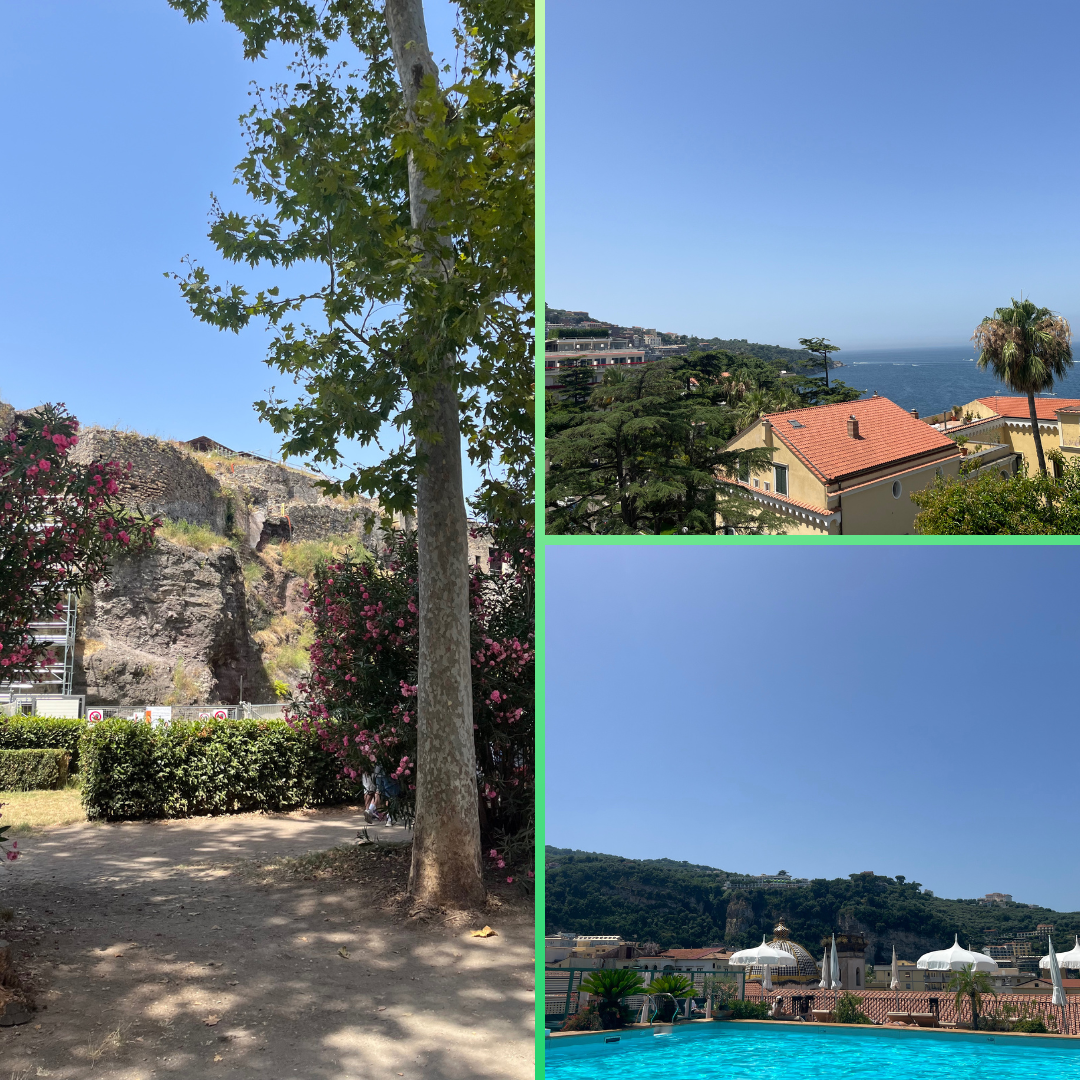
In Sorrento we were able to look around as we walked to a beautiful hotel where we had a rooftop lunch that was infinitely better than the one in Florence. There was wine–and it was breezy and cool enough to actually have a few glasses without feeling dizzy–salad, chicken, and a fantastic cheesecake for dessert. We were seated with a lovely family with two girls exactly our girls’ ages who had an almost identical story to ours–senior vacation delayed by pandemic. They were from Michigan, however, so they were not quite accustomed to the level of heat we were experiencing, and the mother was dreading seeing Pompeii with the blazing sun.
She was right to be concerned. It was, in a word, hot, and our guide said that it was a heat even most Italians were unaccustomed to. But for us it was oh so very worth it. The girls ambled through the streets, jumping from large stepping stone to large stepping stone. They told stories from Latin class, took selfies in front of buildings, laughed, and seemed to have a really good time. My husband and I hung back, letting them have their shared sister-moments. Looking into homes of the past my mind once again began layering memories. I couldn’t help but think of the Dr. Who and Loki episodes set in Pompeii, and the cultural resonance of the place. At the same time was the devastating understanding that real people once lived here, and many died a horrible death here. Mixed with that were the snippets I’d learned from my kids about Roman culture based on the excavations done in Pompeii. It was intellectually invigorating, fascinating, humbling and sad all at the same time.
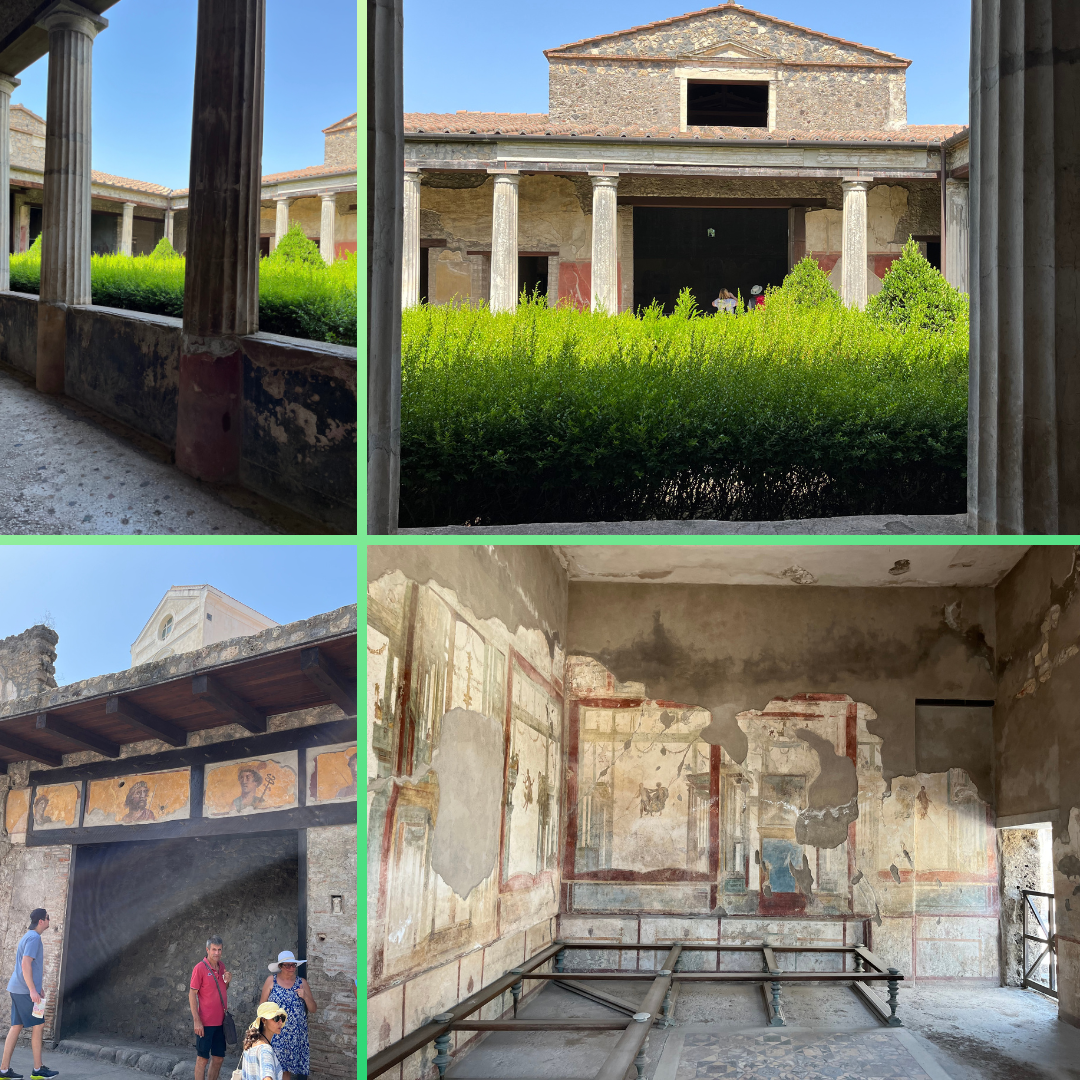

It looked like it had been an amazing city. The amphitheater alone was enviable. We toured some houses and the gymnasium, but the brothel was honestly the most fascinating part–especially the wall art which was essentially a menu for those who didn’t speak the language. Evidently, everything was available in Pompeii. It was like Roman Vegas. Our tour ended in a huge square, behind which stood deadly Vesuvius. We had no time to do more than rush through the museum–which displayed mummified figures from the city that were both fascinating and disturbing–to get to the bus.


If this entire trip was a song, the verses would have held details of our daily experiences and the chorus would have been “I could have spent far more time there, and I was sad to have to leave.” Pompeii might have had two verses and a repeat of the chorus. There was just so much more I wanted to see and do.
However, I was happy because my daughters were happy. This excursion had given them at least one day of joy and connection with both the historical past, and their personal past. Watching them together brought me more joy than I can express. I was so happy to see them once again engaging in their lifelong friendship, reveling in their memories of school together, and connecting after almost a year apart. Most of all, I was incredibly happy that in Pompeii, at least, our family was able to both enjoy the history and culture of the place while also connecting with each other. But the question remained–would that happen on our final destination of the trip, Rome?
Categories: Art, Diane's Voice, Living, Sister Sirens


 The Gloria Sirens
I love how you captured the essence of travel – always wanting to stay longer.
LikeLike